Newborn Sleep Survival Guide: The First 12 Weeks
Newborn sleep in the first twelve weeks is chaotic, and the chaos is the normal part. Most newborns sleep a lot in total — often somewhere around 14 to 17 hours a day — but in short, scattered stretches, with no real day-night rhythm until roughly week 8 to 12. You cannot schedule your way out of this stage. What you can do is keep sleep safe, match your expectations to the week you’re actually in, and run the nights with a simple plan instead of 2am guesswork. Here’s the guide I wish someone had handed me in the hospital parking lot.
First, the non-negotiables: safe sleep
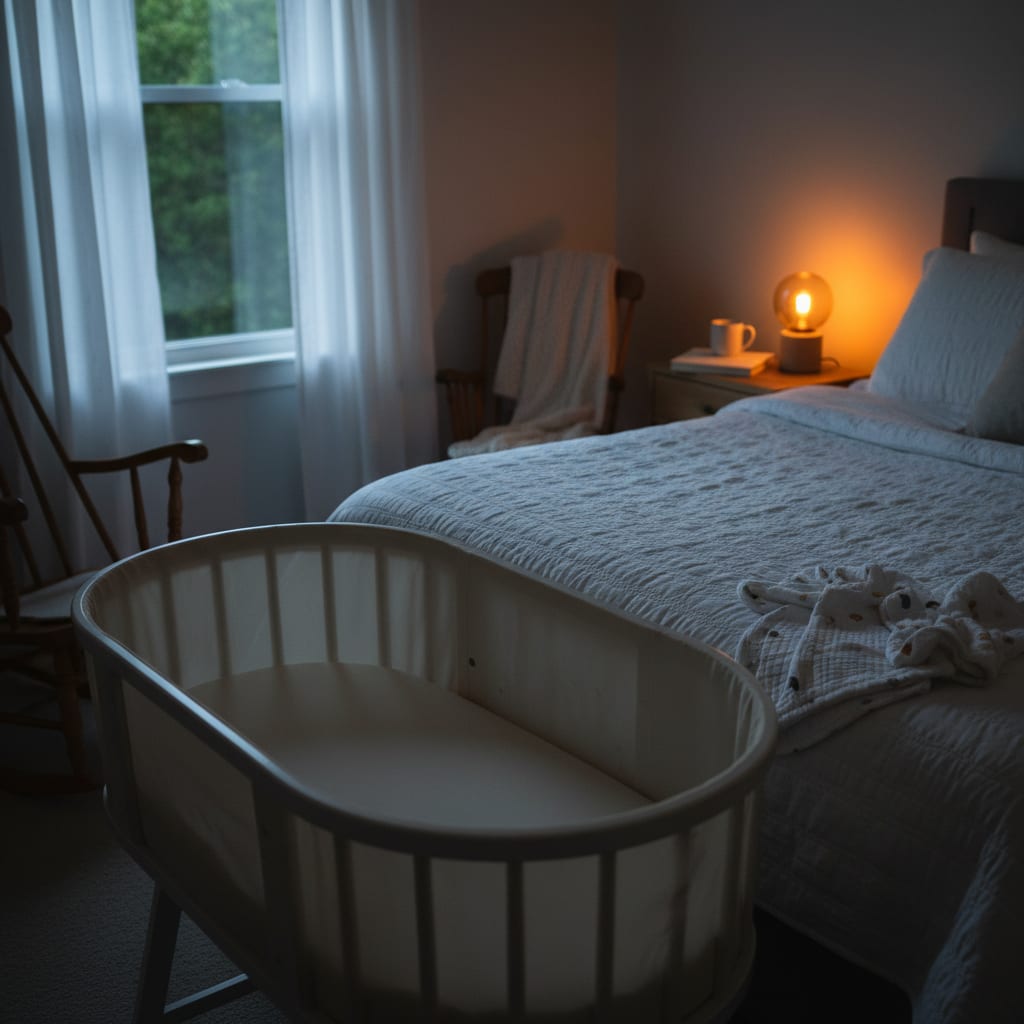
Before any survival tactics: the safe-sleep basics come from the American Academy of Pediatrics, and they outrank every tip on the internet, including mine. Baby on their back, every sleep. A firm, flat surface — bassinet or crib — with nothing else in it: no blankets, pillows, bumpers or stuffed animals. Room-sharing (not bed-sharing) is recommended for at least the first six months. If anything about your setup feels uncertain, ask your pediatrician at the next visit — that’s exactly what those appointments are for.
Weeks 0–4: the fog
Nobody is confused in week one — the baby sleeps constantly. The surprise is when: many newborns have their days and nights flipped at first, snoozing through afternoons and partying at 3am. Feeds come around the clock, often bunched into marathon evening sessions — that’s cluster feeding, and it’s normal, not a supply problem.
What helped us in the fog: keeping nights dark, quiet and boring (feed, change, back down, no eye contact — you’re a polite stranger at 3am), letting daytime be bright and noisy to help the day-night flip sort itself out, and doing shifts with my husband so each of us got one protected chunk of sleep. Lower the bar on everything else. This is the part people mean when they say “survival mode.”
Weeks 4–8: the fussy peak
Somewhere around week five or six, many babies hit peak fussiness — more crying, harder evenings, shorter tempers all around. Evening meltdowns get so predictable that they have a name: the witching hour, and it deserves its own survival plan. Fighting sleep while clearly exhausted is standard issue at this age; overtiredness sneaks up fast because newborns can only comfortably stay awake for very short stretches.
The good news hiding in this stage: social smiles usually show up around week six, which is nature’s way of keeping everyone on the project. And by the end of this window, many babies start giving one slightly longer stretch of night sleep. When you get it, sleep — do not use it to fold laundry.
Weeks 8–12: the first real rhythms
This is where the fog starts lifting for many families. Babies gradually become more awake and alert in the day, evenings often calm down, and something resembling a pattern — not a schedule, a pattern — starts to appear. Some babies begin managing a longer first stretch of night sleep; others take a few more weeks. Both are normal, and your pediatrician is the referee on anything weight- or feeding-related, not the app on your phone or the neighbor whose baby “slept through at eight weeks.”
What actually helped us survive
- A wind-down that never changes. Short and boring: dim lights, feed, swaddle or sleep sack (a Halo SleepSack Swaddle covers both stages), same song. Babies this age don’t follow clocks, but they do start to recognize sequences.
- Shifts, not martyrdom. One parent owns 9pm–2am, the other 2am–7am, whatever splits the night — each of you gets one defensible block of sleep.
- Tracking less. Week two me logged every feed and wake-up in three apps and was more anxious for it. Numbers matter to your pediatrician; obsessing over them at home mostly manufactures dread.
- A plan that isn’t in your head. The single biggest upgrade for us was outsourcing the “what do we do right now?” question. We used Betteroo, a personalized baby-sleep app: you answer questions about your baby and your parenting style, and it builds a gentle day-by-day plan — today’s naps, tonight’s bedtime — that adapts as the baby grows. At 3am, “the plan says hold bedtime at 7:45” beats two exhausted people negotiating from memory. Honest caveat: it’s a tool, not a miracle — no app makes a three-week-old sleep through the night, and nothing should override your pediatrician. What it removes is the figuring-out, which is half the exhaustion.
 Stop guessing at 3am
Betteroo builds a personalized, gentle day-by-day sleep plan for your baby — today's naps, tonight's bedtime — and adapts it as they grow.
Take the 2-minute sleep quiz →
Stop guessing at 3am
Betteroo builds a personalized, gentle day-by-day sleep plan for your baby — today's naps, tonight's bedtime — and adapts it as they grow.
Take the 2-minute sleep quiz →
When to call the pediatrician
Normal newborn sleep is messy, but some things are phone calls, not phases: a baby who is unusually hard to wake or dramatically sleepier than their own normal, fever in a baby under three months (call right away), fewer wet diapers than your pediatrician told you to expect, breathing that worries you, or a baby who seems too sleepy to feed. And if it’s you who isn’t okay — rage, despair, or anxiety that won’t lift — call your OB; that conversation is just as urgent as any baby question.
FAQ: newborn sleep, weeks 0–12
How much should a newborn sleep?
Lots in total — commonly somewhere around 14 to 17 hours across a day — but in short bursts of a few hours at most, around feeds. Wide variation is normal; your pediatrician tracks what matters at checkups.
When do babies sleep longer stretches at night?
Many babies start giving one longer night stretch somewhere between 6 and 12 weeks, but the range is wide and progress isn’t linear. A rough week after a good one doesn’t mean you broke anything.
Should I put my newborn on a sleep schedule?
Not a clock schedule — newborns aren’t built for it. A repeating rhythm of eat, play, sleep plus a consistent wind-down is plenty. A personalized plan like Betteroo’s can handle the timing math as the rhythm evolves.
Is it normal for my newborn to fight sleep at night?
Extremely, especially in the evening weeks 2 through 8 — that’s the witching hour and it fades. If crying ever feels different or unstoppable and your gut says something’s wrong, call your pediatrician.