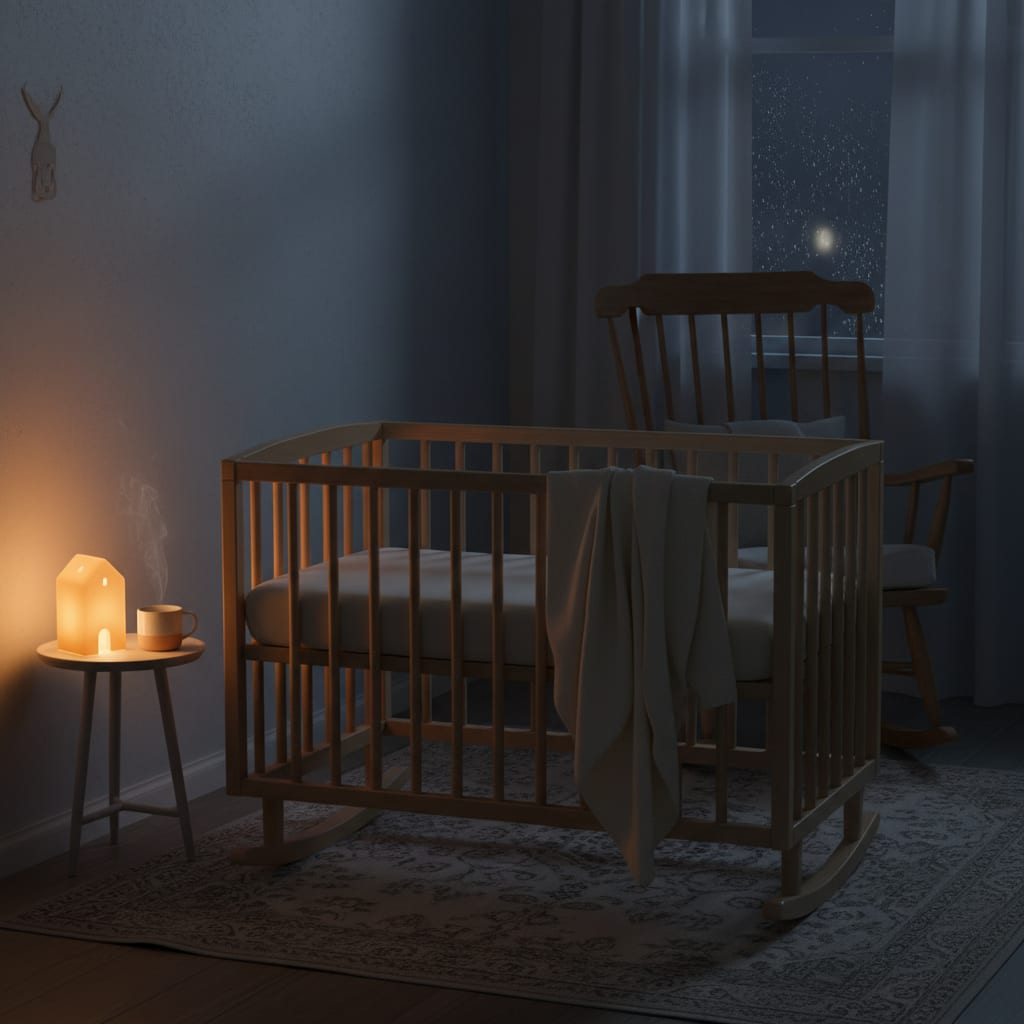
The 4am Wake: Is Your Baby Hungry or Just Awake?

The 4am wake is the one that breaks people, because you can never tell in the moment whether you’re feeding a hungry baby or teaching a rested one that 4am is snack time. The short answer: a hunger wake builds — she stirs, roots, works up through cues, feeds with real purpose and goes back down heavily. A habit wake is abrupt, half-hearted at the breast or bottle, and followed by a baby who is awake and cheerful. Age matters enormously too. Here’s how to read it.
The hungry 4am wake, described
Genuine hunger has a shape, and the shape is gradual. She surfaces slowly: stirring, head-turning, hands to the mouth, rooting against whatever her cheek finds, and small fussing sounds that escalate if nothing happens. Crying is the last stage of hunger, not the first — which is why 4am feeds so often start badly.
Then the feed itself tells you. A hungry baby latches immediately and feeds with intent: long rhythmic sucking, audible swallows, sustained for a real stretch rather than a token minute. She comes off heavy and unfocused and goes back down without a fight. That is a feed that was needed.
The daytime context corroborates it. Hunger wakes cluster when something has shifted — a growth spurt, a day of distracted short feeds, a nap schedule that ate a feed, or the first weeks of solids displacing milk before the balance settles. If 4am appeared alongside one of those, the odds are it’s real. Betteroo’s guide to reading a baby’s hunger signals breaks the sequence down by stage; our own newborn hunger cues post covers the early signals.
The habit wake, and why it looks so convincing
A habit wake — more precisely, a wake where feeding has become the way back to sleep rather than the reason for waking — looks different if you watch it rather than react to it.
It’s abrupt: silent to crying in seconds, no build-up, no rooting. She latches and does a few minutes of light fluttery sucking with long pauses and few swallows, or takes a token amount and turns away. Then she either falls asleep on the feed almost instantly — a settling tool, not a meal — or comes off wide awake and ready for the day at 4:15am.
The other tell is consistency. A habit wake lands at almost the same minute every night, because it’s been reinforced at that time. Real hunger drifts; a learned association is punctual.
None of which makes the feed wrong. Feeding a baby back to sleep at 4am is a reasonable thing to do at almost any age — the only question is whether you want to keep doing it, and knowing which wake you’re dealing with is how you decide.
Telling them apart by age
Whether she still needs it depends on her weight and growth, and your pediatrician holds both. But the general picture changes across the first year.
Newborn to about three months. Assume hunger. Frequent night feeds are expected and necessary, small stomachs empty fast, and how long a newborn can safely go between feeds is a medical question rather than a target you set. There is no such thing as a bad habit at this age.
Around four to five months. This is where it genuinely blurs: sleep reorganises around four months and babies start surfacing between cycles, so wakes multiply and not all of them are hunger — but growth is fast, so some are. The worst age to guess, and the best age to just feed and revisit in a month. The four-month post covers why the sleep changed.
Around six to eight months. Solids have started, milk still does most of the nutritional work, and babies diverge hugely. Some genuinely need an overnight feed, particularly breastfed babies; some are waking out of pure association. This is the age where the question is worth actually asking, and where the answer will be specific to your baby.
At every age, a wake that is new deserves suspicion of something other than habit before you change anything.
 4am again? Find out what she's actually asking for
Betteroo builds a gentle, personalized sleep plan around your baby's real age and rhythm, and adapts it as she changes.
Take the 2-minute sleep quiz →
4am again? Find out what she's actually asking for
Betteroo builds a gentle, personalized sleep plan around your baby's real age and rhythm, and adapts it as she changes.
Take the 2-minute sleep quiz →
The three-night test
If the question is genuinely open — and you’ve checked with your pediatrician that skipping an overnight feed is reasonable for her weight and growth — there’s a low-stakes way to find out without a plan, a program, or a bad week.
For three nights, change nothing. Just note four things: what time she woke, how she woke (gradual and rooting, or abrupt), how long and how hard she actually fed, and what she did afterwards. Three nights of “abrupt at 4:05, five minutes of fluttering, awake for the day” tells you one thing. Three nights of “stirring from 3:50, twenty minutes with swallows, back down until seven” tells you the opposite.
If it reads as habit, change one thing and give it a week — usually shortening the feed slightly each night, or sending in the parent who can’t feed her. An association tends to fade fast once it stops being available. Betteroo’s walkthrough of night weaning covers the gentle versions properly, and a dream feed is the other lever — it works for some babies and backfires for others.
When 4am is neither
Before you conclude anything, rule out the boring stuff.
Light. A gap in the curtains at the wrong angle can end a night, and the angle shifts as the year turns. Blackout curtains are cheap and disproportionately effective.
Temperature. The small hours are the coldest part of the night. A baby who’s kicked off her covering, or who’s overheating in too many layers, surfaces then. Loose blankets stay out of the crib for the whole first year, so warmth comes from what she’s wearing.
Noise, and the absence of it. A silent house makes every boiler click and every bird audible. Steady white noise from a Yogasleep Dohm, left on all night rather than switched off after settling, smooths that out.
Teeth, illness, a blocked nose. All hit hardest lying flat. A baby waking at 4am and off her feeds and miserable in the day is telling you something else entirely.
Day sleep in the wrong shape. A huge late nap, or a baby who reached bedtime overtired, both produce a 4am wake that has nothing to do with her stomach.
And if the real problem is that you can’t get back to sleep afterwards, that’s a different post: surviving night feeds covers the harder half.
Talk to your pediatrician if…
Talk to them before dropping any overnight feed, especially under six months or if growth has been watched. Call sooner if: wet diapers drop below her normal; she’s feeding less overall, not just at night; she’s much harder to rouse, floppy or unusually limp; she has a fever of 100.4°F (38°C) or higher; the waking arrives with vomiting, laboured breathing, or crying that’s high-pitched or inconsolable; or a baby who was gaining well seems to have stalled. And for you: if the nights have tipped into something darker than tiredness, that’s a same-day call to your OB or the PSI helpline.
FAQ: the 4am wake
How do I know if my baby is hungry at night or just habit?
Watch the build-up and the feed. Hunger builds gradually with rooting and cues, and produces a long feed with real swallowing followed by heavy sleep. A habit wake is abrupt, punctual to the minute, and produces a short fluttery feed and a baby who’s either instantly asleep or wide awake.
Should I feed my baby every time she wakes at 4am?
Under about three months, yes — night feeds are needed and there’s no habit to worry about. Older than that, it depends on your baby’s growth and weight, which makes it a pediatrician question. Feeding her back to sleep is never harmful; it’s just not always necessary.
Will solids stop the 4am wake?
Not reliably. Solids are added to milk rather than replacing it for most of the first year, and the evidence that food buys longer nights is weak. Some 4am wakes actually appear during early solids, when milk gets displaced before the balance settles.
Why does my baby wake at exactly 4am every night?
Punctuality points away from hunger and toward something environmental or learned — light, temperature, a noise on a schedule, or an established association with being fed back to sleep. Real hunger drifts. Check the room first; it’s the cheapest fix. You’re doing fine.