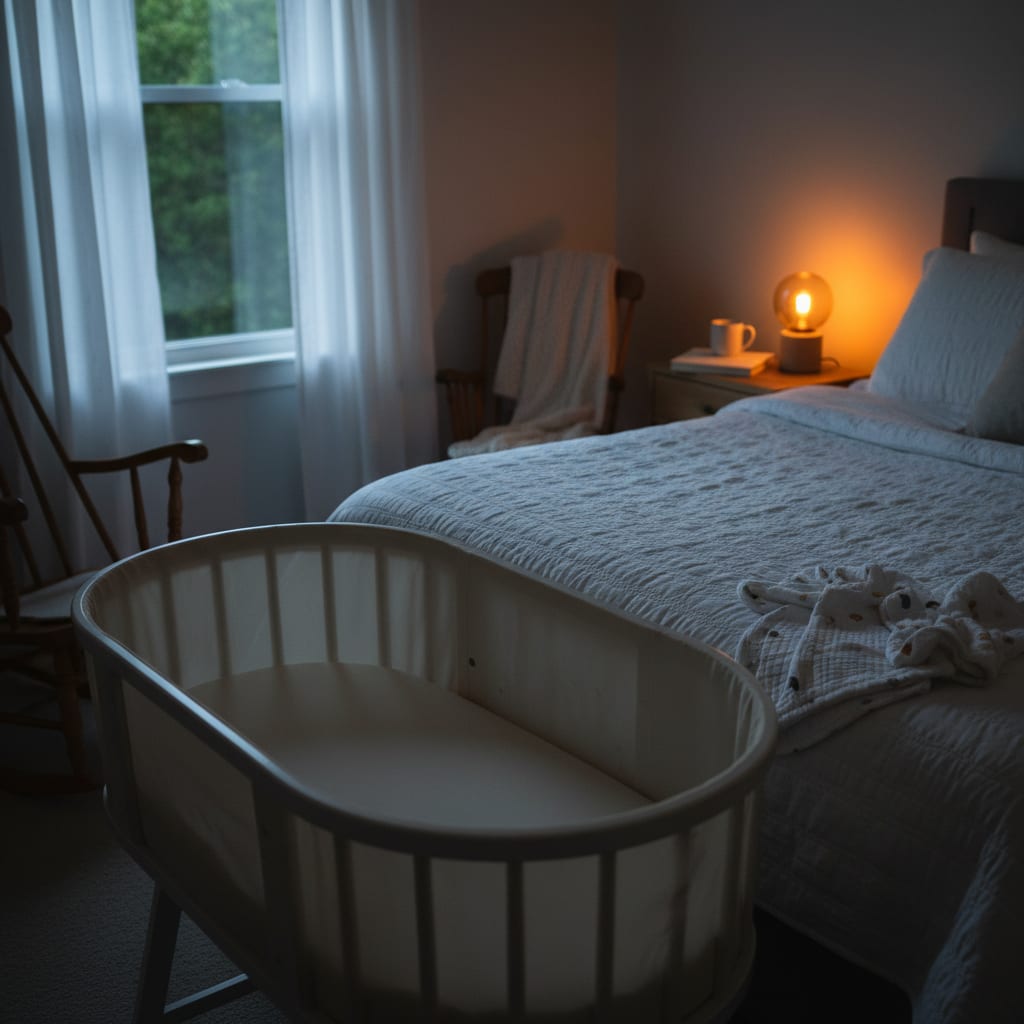
Dream Feeds: What They Are & Whether to Bother

A dream feed is a feed you give your baby while she’s still mostly asleep — usually somewhere around 10 or 11pm, right before you go to bed — in the hope that a topped-up baby will push her next waking further into the night. That’s the whole concept. It works beautifully for some families, does nothing at all for others, and occasionally makes the night worse by waking a baby who was doing fine. It’s worth a week’s trial and not worth a fight. Here’s how to run that trial honestly, and how to tell which camp you’re in.
What a dream feed actually is
You lift her from the bassinet without turning the lights on or talking, offer breast or bottle, let her feed drowsily, wind her briefly, and put her back down. She may never fully open her eyes. No diaper change unless it’s genuinely needed, no chat, no music, nothing that reads as morning.
The word “dream” is doing some work there — plenty of babies wake up properly during it, and that’s still fine. What makes it a dream feed rather than a night feed is that you chose the timing instead of her.
The theory, and what it’s actually based on
The logic is simple: newborns wake for a mixture of hunger and habit, and the longest sleep stretch of the night usually falls in the first half — the part you spend awake watching television. If you can pull a feed forward into that window, the argument goes, you bank her longest stretch for yourself instead of sleeping through it and then being woken forty minutes after you finally turn in.
The honest caveat is that this is a widely used practice rather than a strongly evidenced one. There’s no good research showing dream feeds reliably lengthen night sleep, and there is a lot of parental experience saying it did or didn’t. Treat it as a low-cost experiment, not a rule.
How to try one
- Pick the timing off your own bedtime, not the clock. Feed her right before you get in bed, whether that’s 10pm or 11:30pm. A dream feed you’re awake for at 1am has missed its point entirely.
- Keep the room dark and dull. Lowest possible light, no talking, no changing table unless there’s a leak situation.
- Wake her just enough to feed well. A hand on the chest, the nipple or bottle brushed against her lips, maybe a foot unwrapped. A baby too asleep to latch properly will half-feed and wake hungry an hour later, which is the worst of both worlds.
- Pace a bottle the same way you would at noon. Upright, slow flow, pauses — paced bottle feeding matters more at night, not less, because a gulped feed comes back up on a flat baby.
- Wind her, briefly, upright against your shoulder. Skipping this is how you end up doing the whole thing again in twenty minutes.
- Straight back down on her back, in her own bassinet or crib, on a firm flat bare surface. Same safe-sleep rules as every other sleep, and never in your bed or on a sofa “just for the dream feed” — falling asleep with her on a sofa or armchair is the genuinely dangerous version.
- Run it for five to seven nights before you judge it. One night proves nothing; babies have random nights in both directions.

How to tell whether it’s working
Track one number for the week: the time of her first waking after you go to bed. If that time is consistently later than it was without the dream feed, keep it. If it’s identical, you’ve swapped one wake-up for another and you can drop it without guilt. If it’s earlier, or she’s now waking twice where she woke once, stop — you’re waking a baby who was managing.
That third outcome is more common than the dream-feed evangelists suggest, particularly with light-sleeping newborns. Betteroo’s longer breakdown walks through the age ranges where it tends to pay off.
When it isn’t worth bothering
In the first few weeks. A newborn feeding every two to three hours around the clock is already being fed at 10pm — you’d just be renaming it. Dream feeds make more sense once some kind of longer first stretch has appeared, which for most babies is somewhere in the second or third month.
If she wakes fully and takes an hour to resettle. Some babies simply don’t do drowsy. If putting her back down after a dream feed becomes a project, you’ve bought yourself less sleep, not more.
If her clock is upside down. A baby who sleeps all afternoon and parties from midnight needs the day fixing first — day-night confusion doesn’t respond to an extra feed.
If you’d have to set an alarm for it. Waking yourself out of deep sleep to feed a sleeping baby is a net loss and a genuinely bad trade.
The rule that overrides all of this
Newborns feed on cue, and no newborn should be pushed toward longer stretches at night to fit an adult schedule. If your baby wakes hungry before your planned dream feed, feed her. If your pediatrician has asked you to wake her for feeds — common with early weight-gain concerns, jaundice or prematurity — their instructions replace everything on this page. Once she’s growing well and your pediatrician is happy, letting her sleep is fine, and the newborn sleep survival guide covers what to expect stretch by stretch.
FAQ: dream feeds
What time should a dream feed be?
Whenever you’re going to bed, most often between about 10 and 11:30pm. It’s timed to your night, not to a rule.
Should I change her diaper during a dream feed?
Only if it’s soaked through or dirty. A dry-ish diaper is not worth the wake-up, and most newborn diapers handle a night stretch fine.
Can I dream feed with a bottle if I’m breastfeeding?
Yes, and it’s one of the better ways to hand a night stretch to a partner. If your supply matters to you, pump when the bottle is given so your body still registers the removal — that logistics puzzle is covered in surviving night feeds.
When should we stop dream feeding?
When it stops buying you anything, or when she starts sleeping through it, or when she begins refusing it — often somewhere in the middle of the first year. There’s no need to taper anything; you just stop. Weaning the dream feed walks through the signals and the first three nights without it.