Your 7-Month-Old Baby: On the Move and Onto Textures
A 7-month-old baby has stopped staying where you put her. Sitting is steady enough to free up both hands, which means everything within arm’s reach is now in play; some babies are commando-crawling, rocking on all fours, or reversing themselves under the sofa. Food has textures now, babbling has consonants, and there is no well visit this month to structure things. Here’s what’s normal at seven months, what changes, and what’s worth a call.
What’s changing at seven months
Month seven is a movement month, but the honest version comes with a caveat most articles skip: the CDC removed crawling from its milestone checklists in the 2022 revision. It wasn’t an oversight. The checklists were rebuilt around what about 75% of babies do by a given age, and crawling had no solid normative data behind it — partly because a meaningful number of babies never crawl at all. They scoot on one hip, roll to their destination, drag themselves by the forearms, or sit still until they simply stand up and walk. All of those are ordinary.
So the useful frame for seven months, again, is a bracket between the CDC’s six- and nine-month checklists. Behind you: rolling tummy-to-back, pushing up on straight arms, leaning on hands to sit, laughing, taking turns making sounds, reaching for a toy she wants. Ahead at nine months: sitting without support, getting to a sitting position by herself, moving things from one hand to the other, banging two things together, looking when you call her name, and babbling long strings like “mamamama” and “bababababa”. A seven-month-old lives somewhere in that stretch — which is a long way from the baby who needed help holding her own head up back at three months. Betteroo’s seven-month milestone guide covers the same window without pretending it’s a schedule.
The one thing that isn’t optional this month is the house. A baby who can move — by any method — needs outlets covered, cords out of reach, heavy furniture and televisions anchored to the wall, and the floor viewed from her eye level, which is where the coins and the dog’s kibble live. Do it before she’s fast, not after.
Feeding at seven months
By seven months solids usually have a rhythm: two, sometimes three small meals a day around milk feeds rather than instead of them. Breast milk or formula is still supplying most of her nutrition — that stays true through the whole first year — so a day where she rejects every spoon is not a nutritional emergency.
What changes is texture. This is the window to move on from perfectly smooth: thicker mashes, soft lumps, and soft finger foods she can pick up and gum. Feeding specialists commonly flag the seven-to-nine-month stretch as a good window to widen the range rather than staying on smooth food indefinitely, and your pediatrician can say how fast to move. Keep going with common allergens rather than avoiding them, and keep new foods spaced a few days apart so a reaction stays traceable. If the allergen framing from the six-month post hasn’t been discussed with your pediatrician yet — particularly if your baby has severe eczema — do that before adding peanut.
She can also start on a cup around now: an open cup or a straw cup with meals, offered rather than insisted on, with small amounts of water. How much water is a pediatrician question; there is a real limit at this age. Betteroo’s seven-to-eight-month feeding walkthrough shows one plausible way a day fits together — a shape, not a prescription.
The first-year rules haven’t moved: no honey before twelve months in any form, and no choking hazards — whole grapes, chunks of meat or cheese, nuts, seeds, raw hard vegetables, popcorn. Upright, supervised, never in a car seat or bouncer.
Sleep at seven months
Seven-month sleep is often good and occasionally sabotaged by the baby’s own new skills. Total sleep sits in the twelve-to-sixteen-hour range including naps, per the guidance the AAP endorses, most commonly as a long night plus two or three naps. Plenty of babies still feed once overnight, and whether yours needs to is a growth-and-weight question for your pediatrician.
What wakes a seven-month-old is usually practice. She sits up in the dark. She gets onto all fours and rocks. She lodges a leg through the crib slats and is outraged. Give the skill daylight hours to mature — floor time is the real fix — and keep nights boring: minimum light, minimum talking, back down, out.
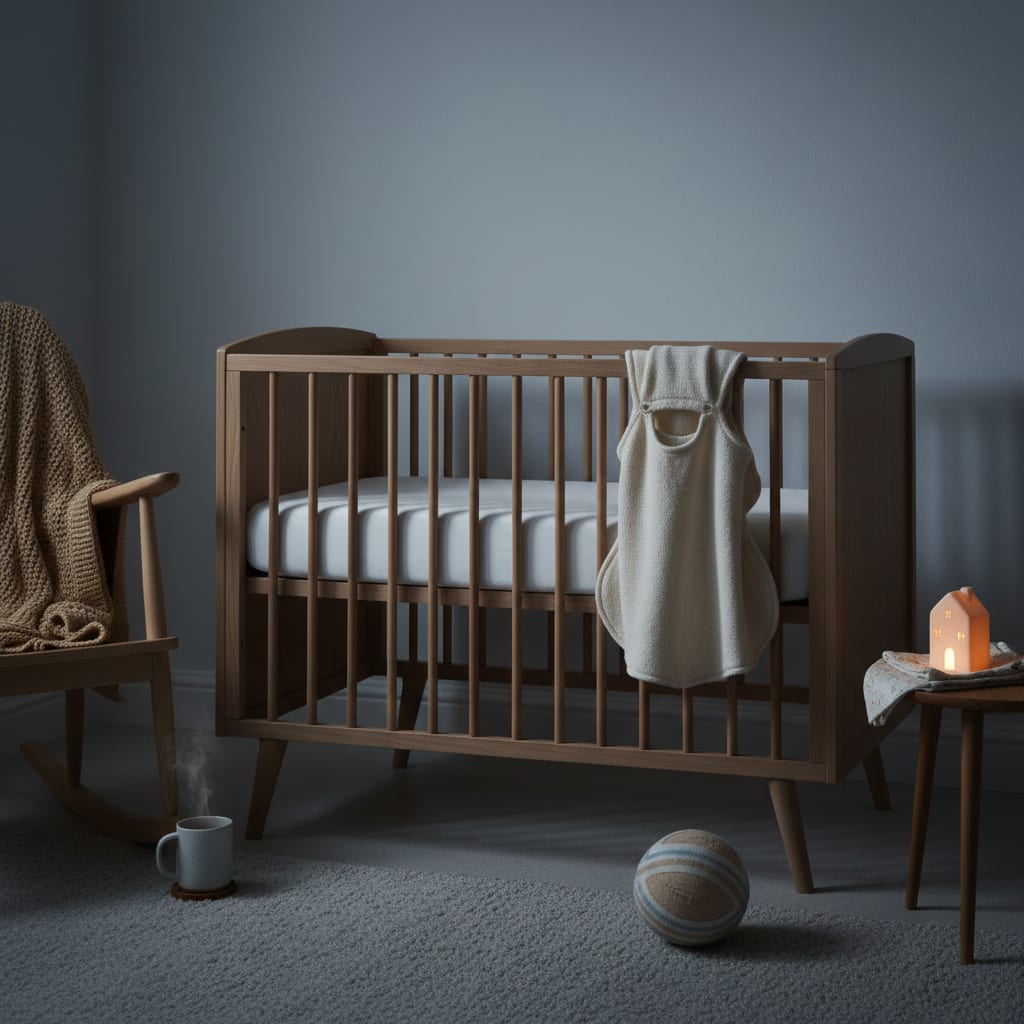
The safe-sleep floor is unchanged. On her back to start, own bare crib, firm flat surface, nothing else in it, no loose blankets, pillows or bumpers for the full first year. Lower the mattress before she can pull to stand, not after — that surprise usually arrives next month.
 Seven months — and she practices at 2am
Betteroo builds a gentle, personalized sleep plan around your baby's real age and rhythm, and keeps adapting it as she grows.
Take the 2-minute sleep quiz →
Seven months — and she practices at 2am
Betteroo builds a gentle, personalized sleep plan around your baby's real age and rhythm, and keeps adapting it as she grows.
Take the 2-minute sleep quiz →
Playing with a seven-month-old
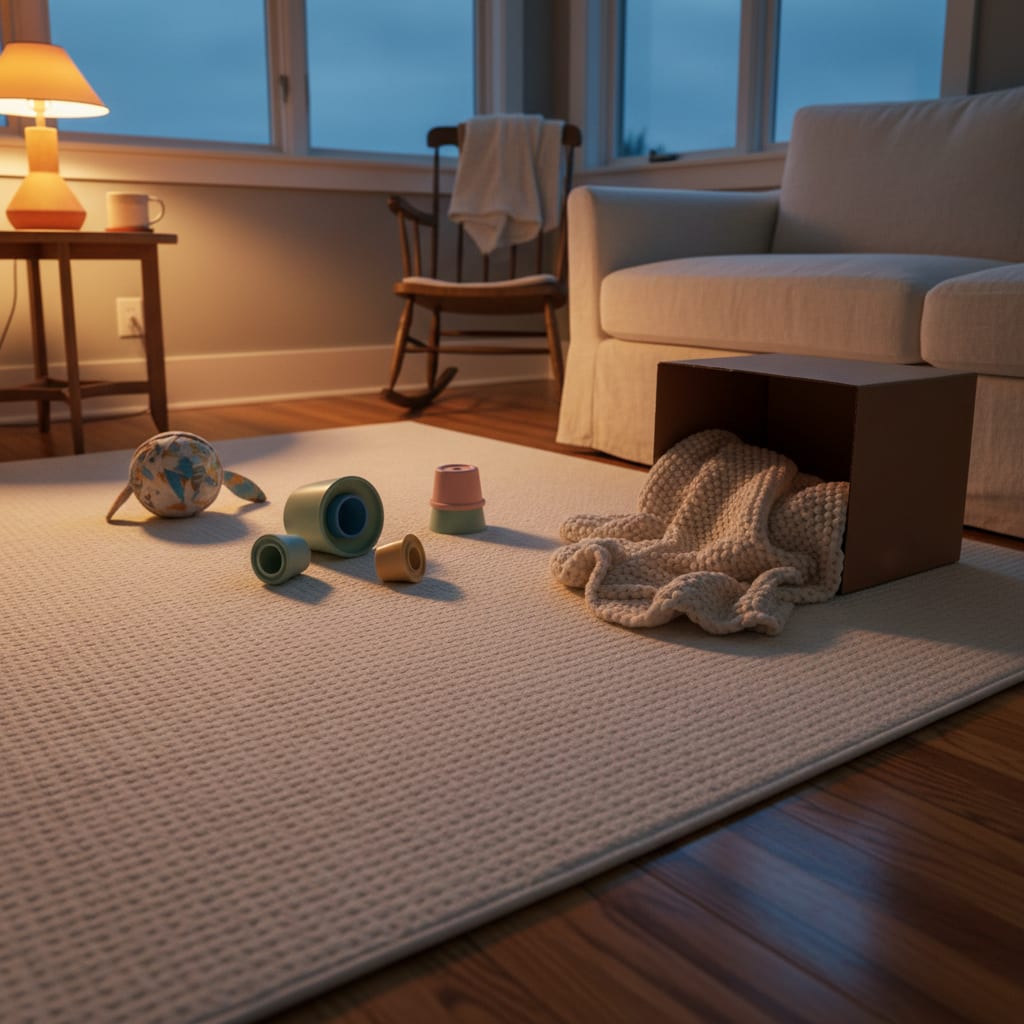
Play gets simpler and messier at once. She wants containers to empty, objects to bang together, things to drop off the edge of a highchair while watching your face for a reaction — that’s cause-and-effect research, not provocation. Peek-a-boo starts to land properly, because the idea that things exist when hidden is under construction. Stacking cups, a set of measuring spoons, a cardboard box and your own face outperform most of what’s sold for this age.
Floor time is the developmental engine of month seven. Not a seat, not a jumper, not a walker — the AAP is clear that infant walkers are a genuine injury risk and shouldn’t be used at all. Floor, supervised, with something interesting placed just out of reach.
Call the pediatrician if…
Call for: a fever of 100.4°F (38°C) or higher; a baby much harder to rouse than usual, floppy, or unusually limp; milk intake or wet diapers dropping below her normal; labored breathing — fast, grunting, ribs pulling in — or blue lips or face; hives, facial swelling, vomiting or wheezing after a new food (call 911 for breathing difficulty or swelling of the face or mouth); vomit that’s green or bloody; no babbling and no vocal turn-taking, no response to her name or to sounds; not sitting with support at all, or sitting and rolling that seem to have gone backwards; a body that stays stiff or floppy; a strong persistent preference for one hand or one side; or the plain “she seems off.” Save everything smaller for the nine-month visit. And for you: a mood that stays dark or frightens you is a same-day call to your OB or the PSI helpline, at any point in the first year.
FAQ: your 7-month-old
When do babies crawl?
There’s a wide normal range, and some babies skip crawling entirely — which is exactly why the CDC dropped it from its milestone checklists in 2022. Scooting, rolling, shuffling on one hip and commando-crawling all count as getting around. What your pediatrician watches is mobility and symmetry, not the technique.
How many meals should a 7-month-old eat?
Commonly two or three small solid meals a day, fitted around milk feeds rather than replacing them. Breast milk or formula still supplies most of her nutrition until twelve months. Appetite swings wildly day to day at this age; your pediatrician’s growth curve is the measure that matters.
Why has my 7-month-old started waking again?
Most often a new skill she wants to practise at 2am — sitting, rocking on all fours, pulling at the slats. Teething and illness are the other usual suspects. Keep daytime floor time generous and night responses short and dull, and it typically settles within a couple of weeks.
What comes after seven months?
Standing, clinging and a baby who has worked out that you can leave the room — your 8-month-old is where separation anxiety usually shows up. It’s a developmental win dressed as a setback. You’re doing fine.