Baby Wakes When You Leave the Room? Why the Door Does It
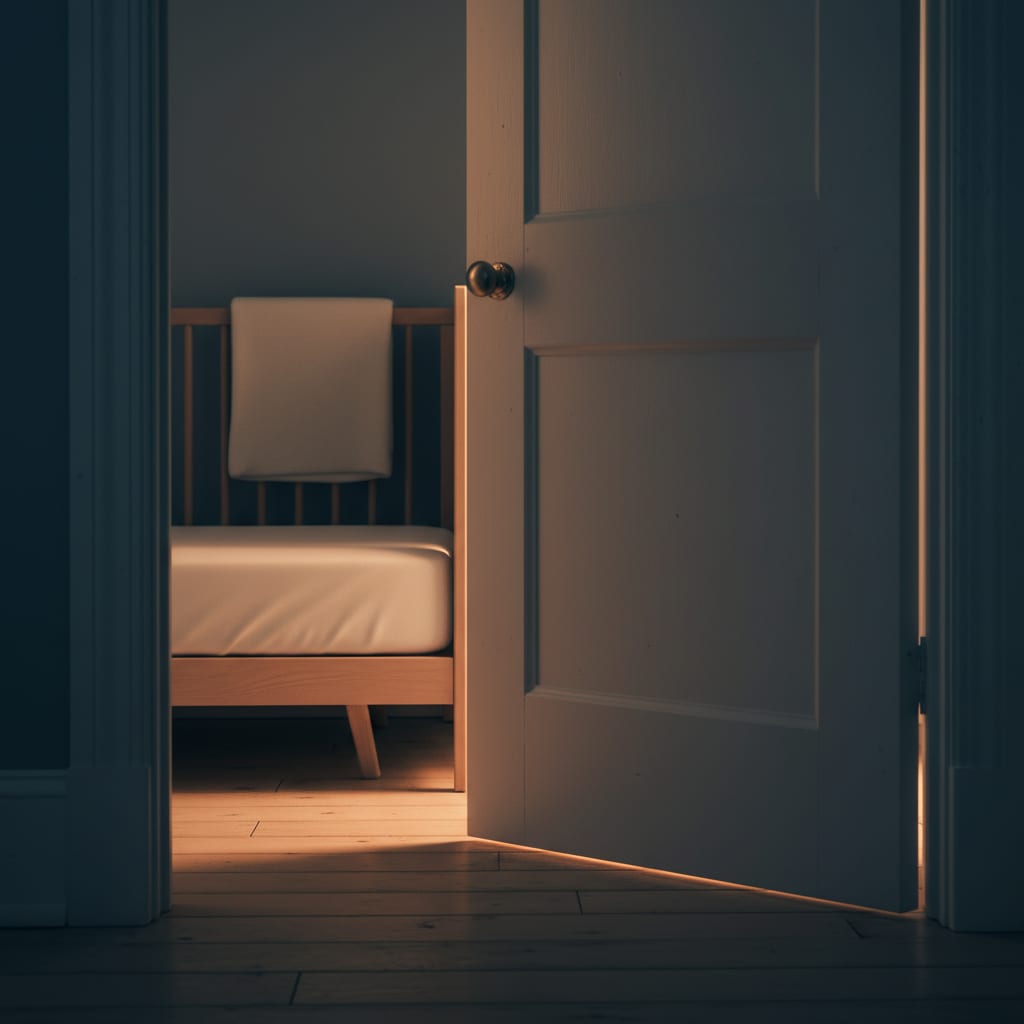
She’s down — limp arm, slack mouth, genuinely down. You cross the room at the pace of a hostage negotiator, ease the door to, and the latch makes that one small metallic sound. And she is awake. It is almost never the door itself: what wakes her is a sudden change against the background she fell asleep in, a step in the sound or the light, landing while she’s still in the lightest part of her sleep. The fix has two halves — make the room the same before and after you leave, and leave later than feels necessary.
It isn’t the door — it’s the change
A baby who sleeps through a passing truck and wakes at a door latch isn’t being contrary. Continuous sound is easy to sleep through; a sharp step out of near-silence is not, and that is exactly what a latch is. The same logic covers the creaking floorboard, the hallway light going off, and — the one nobody thinks of — you. For twenty minutes she has slept inside the sound of your breathing and the small movements of a person in the room, and when you leave it all stops at once. The room she wakes into is not the room she fell asleep in.
Timing is the other half, and the half you can control. The AAP describes newborn sleep as a run of stages: drowsiness, then REM or active sleep in which “the baby may twitch or jerk her arms or legs, and her eyes move under her closed eyelids,” then light sleep, and only then the deep non-REM stages in which “twitching and other movements cease.” Babies front-load the active stuff, so if you leave within a couple of minutes you are leaving during the twitchy part — the part built to notice things.
The test: did she wake at the click, or ninety seconds later?
Worth running for two or three nights; it points at different fixes.
She wakes on the sound itself, within a second or two. That’s a startle at a step change: your problem is the sound floor and the exit technique, and it’s the more fixable of the two.
She wakes thirty to ninety seconds after you’re out, with no obvious trigger. She wasn’t as deeply under as she looked, and what was keeping her there was your presence. The fix is staying longer, not walking quieter.
She never actually landed — she stirs the moment her back touches the mattress. That’s the transfer itself, which wakes a lot of babies four seconds after the descent, and it has its own sequence.
Fixing the exit, in order
Work down the list; the first two solve most of it.
1. Give the room a sound floor. With a continuous low sound running the whole time — before she goes down, while you’re in there, after you leave — the latch stops being a step out of silence and becomes a small event inside an existing hum. It is the highest-return change here. On volume, use the AAP’s plain rule: if an environment “sounds too loud for an adult, it probably is too loud for a child,” and the AAP’s own position is that pediatricians should be counselling families on safe use of sleep machines rather than treating them as risk-free. Ours runs low across the room, never against the rail. Betteroo’s rundown of using white noise sensibly is worth two minutes before you buy anything.
2. Wait for the limp arm. Put her down and stay — hand still on her chest, not patting, not humming, present and boring — until the twitching stops and her hands unfurl. Five to ten minutes usually does it, and it beats the forty-five you’ll spend resettling her if you go early.
3. Kill the click, don’t muffle it. Turn the handle before the door meets the frame, hold the latch retracted as it closes, then release slowly so the bolt slides rather than snaps. Silent every time, and free. Oil a creaking hinge by day.
4. Leave the door in one state. Shut, or open a hand’s width — set it before she falls asleep and don’t change it on the way out. Half the “door problem” is that the door is what changes the room’s light and sound, at the exact moment you go.
5. Learn the floor in daylight. Walk the route from crib to hall in the afternoon, find the boards that talk, and use a different line at night — at one unhurried speed, because the lunge for the door is itself a change in the room’s rhythm.
None of that touches the safe sleep floor: on her back, on a firm, flat, level surface “covered only with a fitted sheet,” nothing soft or weighted in with her, per the NICHD’s Safe to Sleep guidance. A sleep problem is never a reason to prop, wedge or pad anything.
What makes it worse
Tiptoeing. Exaggerated silence creates the contrast you’re trying to avoid, and it produces more creaks than normal walking, because you’re loading the boards at their edges.
Holding your breath. You then have to breathe, audibly, right at the door. Breathe the whole way out.
Going back in to check. A second entry is a second change. If she stirred but didn’t cry, wait it out from the hallway — stirring between sleep cycles is normal and often resolves alone.
Leaving even faster. Understandable, and backwards: every minute you shave off is a minute of active sleep she has to get through without you.
Blaming the door for the room. If she won’t settle in there at all, the order of fixes for a crib she’s rejecting is your diagnosis, as is a baby who fights the run-up to sleep.
When it’s the age, not the door
Somewhere in the second half of the first year this stops being an acoustics problem and becomes a developmental one. The AAP puts it plainly: “beginning in the second half of a child’s first year, separation anxiety can cause many nights with disrupted sleep,” and it “usually fades away somewhere around the second birthday.” Once she understands you exist somewhere else, leaving is a different event, and no latch technique fixes it.
The tell is what happens when she wakes: a startle wake is a stir, a squawk and sometimes a slide back under, while a separation wake is an immediate, escalating, specific protest that stops the moment you appear. Betteroo’s walkthrough of what separation anxiety does to sleep covers how long it tends to last.
 Still creeping out of the room every night?
Betteroo builds a gentle, personalized sleep plan for your baby's exact age, including the falling-asleep half where the door problem actually starts.
Take the 2-minute sleep quiz →
Still creeping out of the room every night?
Betteroo builds a gentle, personalized sleep plan for your baby's exact age, including the falling-asleep half where the door problem actually starts.
Take the 2-minute sleep quiz →
Worth raising with the pediatrician
Most of this is ordinary. Bring it up if she doesn’t react to loud sounds at all — that one is on the CDC’s two-month checklist, and its absence is a hearing question for a clinic, not a sleep post. Also worth a call: waking that is screaming and inconsolable rather than startled; waking that looks like pain — arching, drawing legs up, distress that outlasts being picked up; a baby suddenly much harder to rouse or feeding much less; or the unbeatable “something is off.”
FAQ: the door-shut wake
Why does my baby wake up the second I leave the room?
Because two things happen at once: the room’s sound and light change abruptly, and she’s still in the light, twitchy part of her sleep where changes register. Staying until the twitching stops, and running a continuous low sound so nothing is a sudden step, fixes most of it.
Should I leave the door open or closed?
Whichever you like. What matters is that it’s in the same position when she falls asleep and when she wakes.
Is white noise safe to leave on all night?
It’s commonly done, but the AAP’s advice is to talk to your pediatrician about safe use rather than assume, applying the test that anything too loud for an adult is too loud for a child. Keep it low, well away from the crib, and ask at the next visit.
She used to sleep through anything. Why now?
Sleep reorganizes across the first year, and separation anxiety later arrives on top of it. A baby who slept through a smoke alarm at six weeks and wakes at a latch at seven months hasn’t got worse — she’s got a more grown-up brain. For the wider map, the newborn sleep survival guide covers the first twelve weeks and where it heads next. You’re doing fine.