Babyproofing Before They Crawl: What to Do First
Start babyproofing about a month before you think you need to — realistically somewhere around six or seven months, while she’s still stationary and you still have hands free. And start with the things that injure and kill babies rather than the things a shopping list starts with: anchoring furniture and televisions, turning the water heater down, dealing with blind cords, locking up medicines and cleaning products, and putting gates on stairs. Outlet covers are further down that list than the aisle layout suggests.
Why the timing is “before”, not “when”
Babies do not give notice. The gap between a baby who rolls and a baby who has crossed the room can be a single week, and pulling to stand often arrives without warning in the same fortnight. Everything you do while she’s sitting on a mat takes twenty calm minutes. The same job done the day after she starts crawling gets done badly, at speed, while she’s trying to eat a power cable.
The other reason to go early: the highest-consequence fixes are the ones that need a screwdriver and a free afternoon, not the ones you can slap on in five seconds. Do those first and the fiddly stuff can trickle in later.
The four that actually matter most
Anchor the furniture and the TV. This is the one to do first, and the AAP’s numbers are the reason: a child arrives in an emergency department at least once every hour of every day with injuries from a furniture or television tip-over, and 77% of tip-over deaths between 2000 and 2019 involved children under six. About half of the fatal incidents happen in bedrooms. Straps cost very little and take minutes. Use metal L-brackets rather than plastic, which degrades; use more anchors the heavier the piece; mount flat-screen televisions to the wall or to the furniture, and never park one on a dresser. Drawer stops that prevent full extension matter too — an open drawer is a staircase.
Turn the water heater down. Hot-water scalds are a leading cause of burns in babies and young children, and the AAP’s line is that the hottest temperature at the faucet should be no more than 120°F. On most heaters that’s one dial, once, permanently.
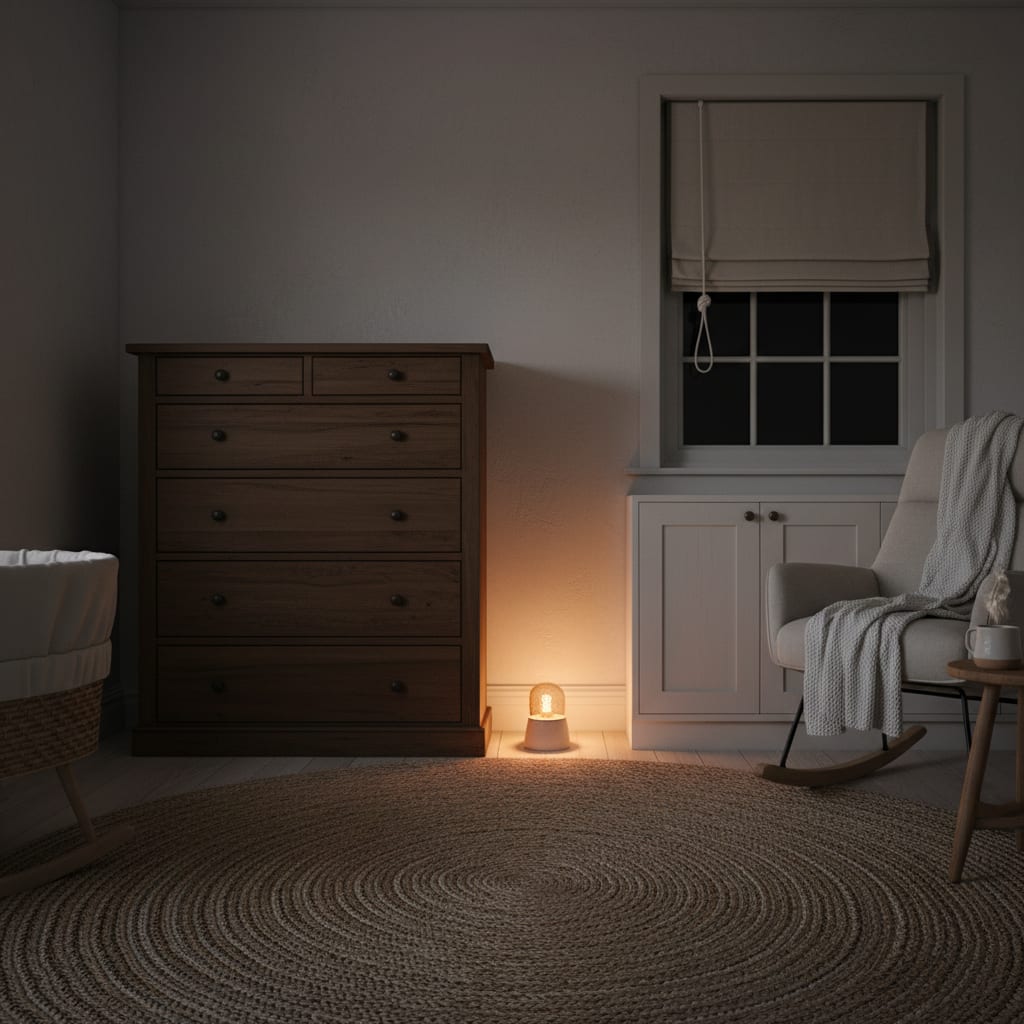
Deal with the cords. Cords from window blinds and draperies can strangle a child. Cordless window coverings are the real fix; if that isn’t possible, the cords get tied high and out of reach. Do this in every room she’ll ever be alone in, including the one with the crib.
Lock up anything that poisons. Medicines, vitamins, cleaning products, laundry pods, alcohol, button batteries — locked cabinets or containers, out of sight and out of reach, not just up high. Put the Poison Help line in your phone now rather than looking for it later: 1-800-222-1222.
Then the ones that follow her body
After the big four, the useful order tracks what she can physically do — which is why this pairs so naturally with the month-by-month picture from eight and nine months.
When she sits and reaches: clear the coffee table of anything small enough to swallow, hot enough to burn, or heavy enough to pull down. Coffee, candles, remote controls with sliding battery doors. Anything that fits through a toilet-roll tube is a choking hazard.
When she moves along the floor: get on the floor yourself and crawl a lap of each room. You’ll find cables, a dropped tablet of something, a coin under the sofa, a bin she can reach, and a dog bowl. That lap is worth more than any list written by somebody who hasn’t seen your house.
When she pulls up: every horizontal surface at standing height becomes reachable, and tablecloths become ropes. Latches go on the kitchen and bathroom cupboards now — a magnetic system like the Safety 1st magnetic locks hides inside the door and opens with a key you keep on the fridge, which is why it survives a determined one-year-old better than the plastic hook kind. Lower the crib mattress the same day.
When she climbs stairs: gates on stairways and doors. The top of a staircase takes a hardware-mounted gate screwed into the wall, like the KidCo Safeway — a pressure-mounted one is fine across a doorway or at the bottom, never at the top. Install operable window guards on every window above the first floor.
 The crib is safe — the nights are the other problem
Betteroo builds a gentle, personalized sleep plan around your baby's real age and rhythm, and keeps adapting it as she grows.
Take the 2-minute sleep quiz →
The crib is safe — the nights are the other problem
Betteroo builds a gentle, personalized sleep plan around your baby's real age and rhythm, and keeps adapting it as she grows.
Take the 2-minute sleep quiz →
The crib is part of the house
It’s easy to babyproof a living room and forget the one place she spends twelve hours a day unsupervised. The crib stays bare for the whole first year — firm flat surface, fitted sheet, nothing else in it. Drop the mattress to its lowest setting before she can pull up, not after. Move the crib away from windows, blind cords, wall hangings and anything she can reach through the bars once she’s standing. Keep the baby monitor and its cord at least three feet from the crib — that warning is printed on the monitors themselves, because monitor cords have strangled babies.
What you can genuinely skip
Not everything sold as a safety product earns its place, and some of it makes things worse.
Baby walkers are the clearest case: the AAP’s position is not to use one at all, because a baby can tip it over, fall out of it, or ride it down the stairs. Corner guards and door-knob covers are optional comfort items rather than safety essentials — a bumped forehead is not in the same category as a dresser. And an over-proofed house can lull you: no latch replaces watching her, and none of this substitutes for the single most protective thing, which is being in the room.
Call for help if…
Call Poison Help on 1-800-222-1222 immediately if she may have swallowed a medicine, a cleaning product, a laundry pod, alcohol, a plant or anything you can’t identify — don’t wait for symptoms and don’t make her vomit. Call 911 for a button battery swallowed or put in a nose or ear, for any difficulty breathing, for choking she can’t clear, for a burn that blisters or covers a large area, or for a seizure or loss of consciousness.
Call your pediatrician the same day after a fall from any height if she vomits, is unusually sleepy or hard to rouse, is inconsolable, has a bump that’s swelling fast, isn’t using an arm or leg normally, or simply isn’t behaving like herself. Any fall from a changing table or a height above her own standing height is worth a call even if she seems fine.
FAQ: babyproofing before crawling
When should I start babyproofing?
Around six or seven months for most families — before she’s mobile, while the job can be done calmly. The gap between rolling and crawling can be a matter of days, and the highest-value jobs, like anchoring furniture, are the slowest ones.
What’s the single most important thing to do first?
Anchor the furniture and the television. It’s the fix with the worst consequences if skipped, it takes minutes, and it needs to be in place before she can pull herself up on a dresser — which typically starts somewhere around eight to ten months.
Do I really need outlet covers?
They’re worth having, but they belong lower down the order than most babyproofing lists put them. Anchoring, water temperature, blind cords, poisons and stair gates all outrank them on real injury data. Do those first, then cover the outlets.
How do I babyproof a house I don’t own?
Almost everything above is renter-friendly. Furniture straps and pressure-mounted gates leave small or no holes, cordless blind clips and cord cleats are removable, magnetic latches mount inside doors, and the water heater dial goes back when you leave. The top of a staircase is the one place worth asking a landlord about a hardware-mounted gate — and most say yes. You’re doing fine.