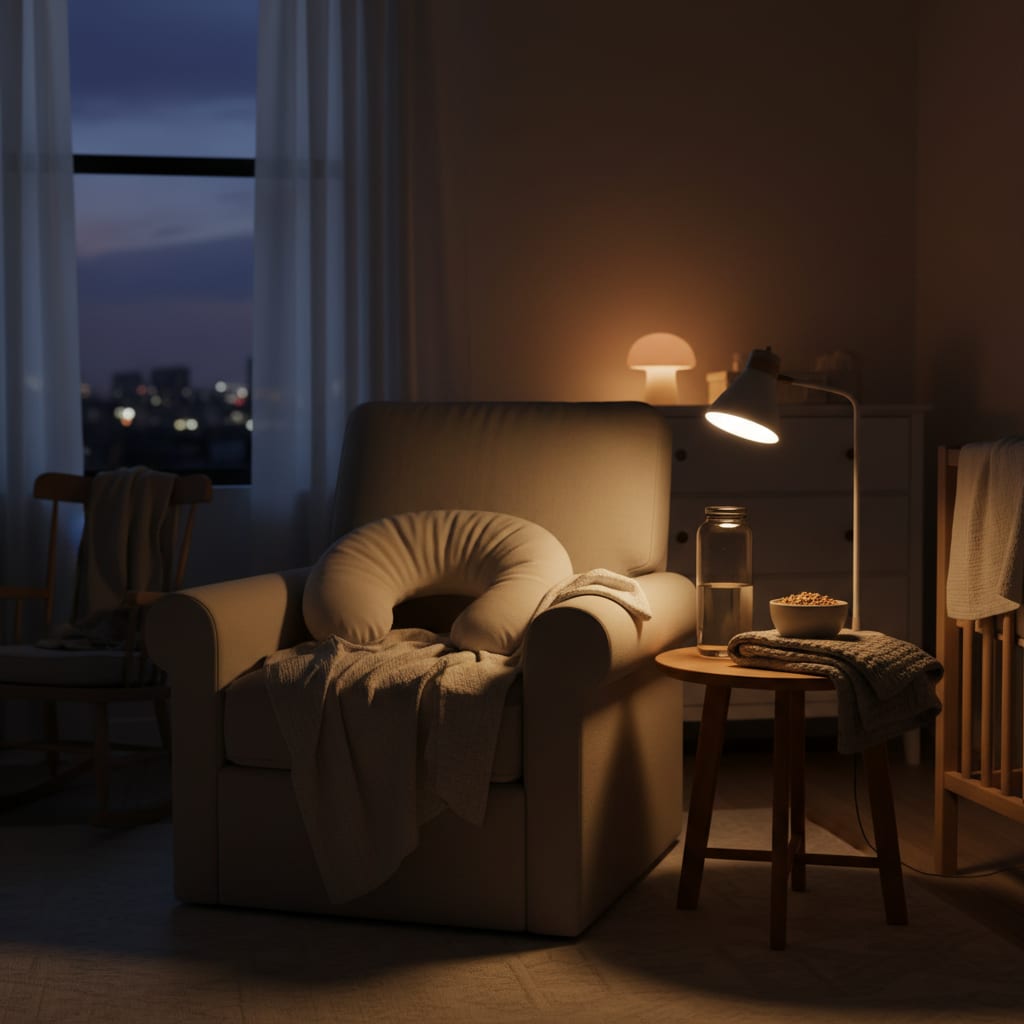
Where Should a Newborn Sleep in the Evening? Downstairs First
Where a newborn sleeps in the evening before you go to bed: in the room with you, in a flat, empty bassinet. How to set up the living room and move her up.
Go straight to: When to call the pediatrician ↓In this entry
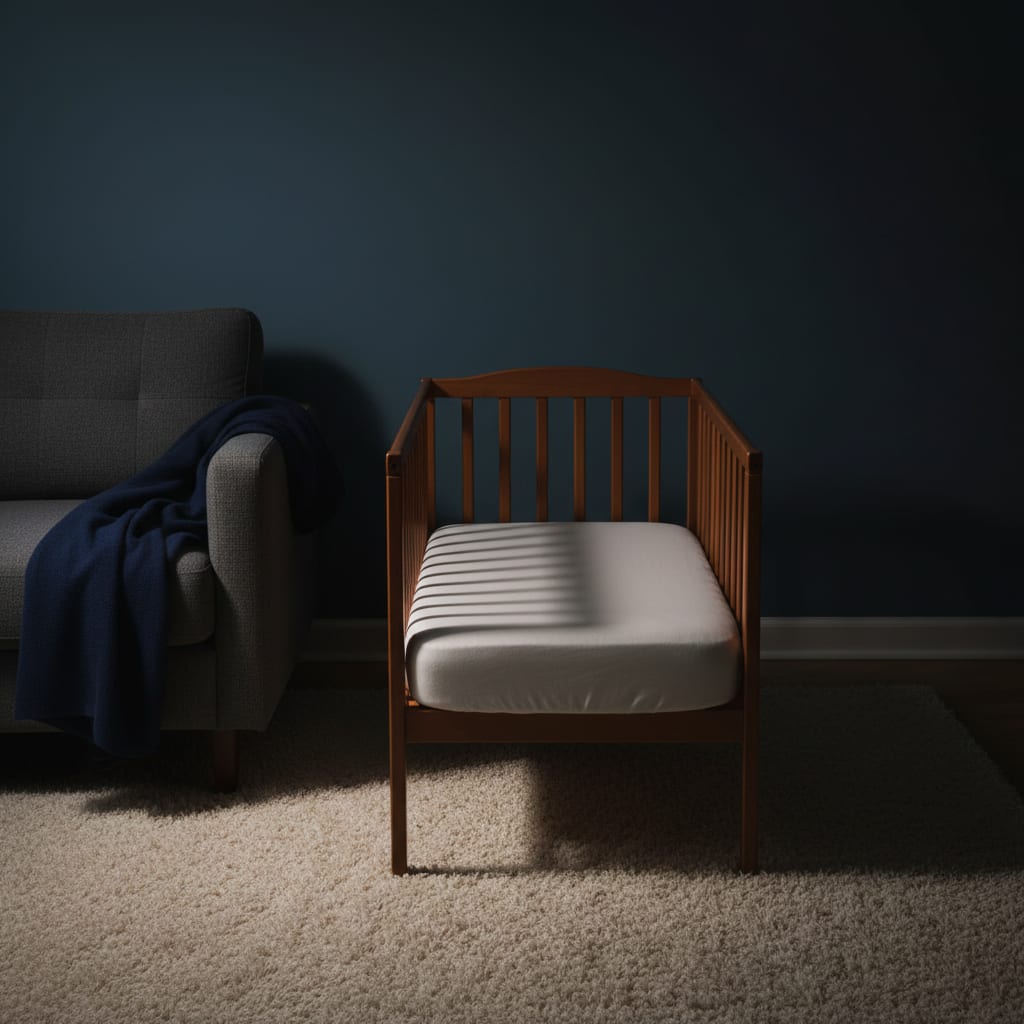
In the evening, before you go to bed, a newborn sleeps best in the room where you are: on her back, in her own flat, firm, empty bassinet or play yard, parked in the living room. When you go up, she goes up with you. The AAP and the NIH’s Safe to Sleep campaign both recommend sharing a room with your baby for at least the first 6 months, with her in a separate sleep space. Neither wants her asleep on the couch, on you while you doze, or left for the evening in a swing or car seat. So for these months the bassinet goes where you go.
Why not just put her to bed upstairs at seven?
Because for the first months, the advice is for her to sleep near you, and at seven o’clock you are downstairs eating dinner with one hand.
The AAP’s wording is to “share a room with your baby for at least the first 6 months of life,” keeping her sleep area “in the same room (close to your bed—but not in the same bed) where you sleep.” It says room sharing can lower the risk of SIDS by as much as 50%, and makes it easier to feed, comfort and watch her at night. The NIH says the same, and adds that it is safer to share your room with your baby than to put her in her own room.
Both of those are written about the night. The evening gap, between her falling asleep and you going to bed, is spelled out most plainly by the Lullaby Trust, the UK safer-sleep charity: “Babies should always be in the same room as you for the first six months for sleep, day and night.” It adds that this “doesn’t mean you can’t leave the room to make a cup of tea or go to the toilet.”
There’s a practical reason too. A newborn’s evening is short naps between feeds, often with a fussy stretch in the middle (that’s the witching hour). You’d be up and down the stairs all evening anyway.
The three places she ends up instead
When there’s no bassinet downstairs, a sleeping newborn lands in one of three spots. Here’s what the AAP and NIH say about each.
| Where | What the guidance says |
|---|---|
| On you, on the couch | Fine while you are wide awake. If you might doze, it’s the riskiest place in the house. The AAP says the risk of sleep-related infant death is “up to 67 times higher when infants sleep with someone on a couch, soft armchair or cushion.” |
| On the couch beside you | The NIH: “Couches and armchairs are never safe places for babies to sleep,” alone or with someone. |
| In the swing, bouncer or car seat | The AAP says if she falls asleep in a car seat, stroller, swing, infant carrier or sling, “move them to a firm sleep surface on their back as soon as possible.” The NIH says not to use sitting devices for naps. |
Every one of these happened in our living room in the first fortnight. Once there was a flat bed for her within arm’s reach of the couch, I stopped having to decide each time.
Setting up the living-room bassinet
You have two ways to do this.
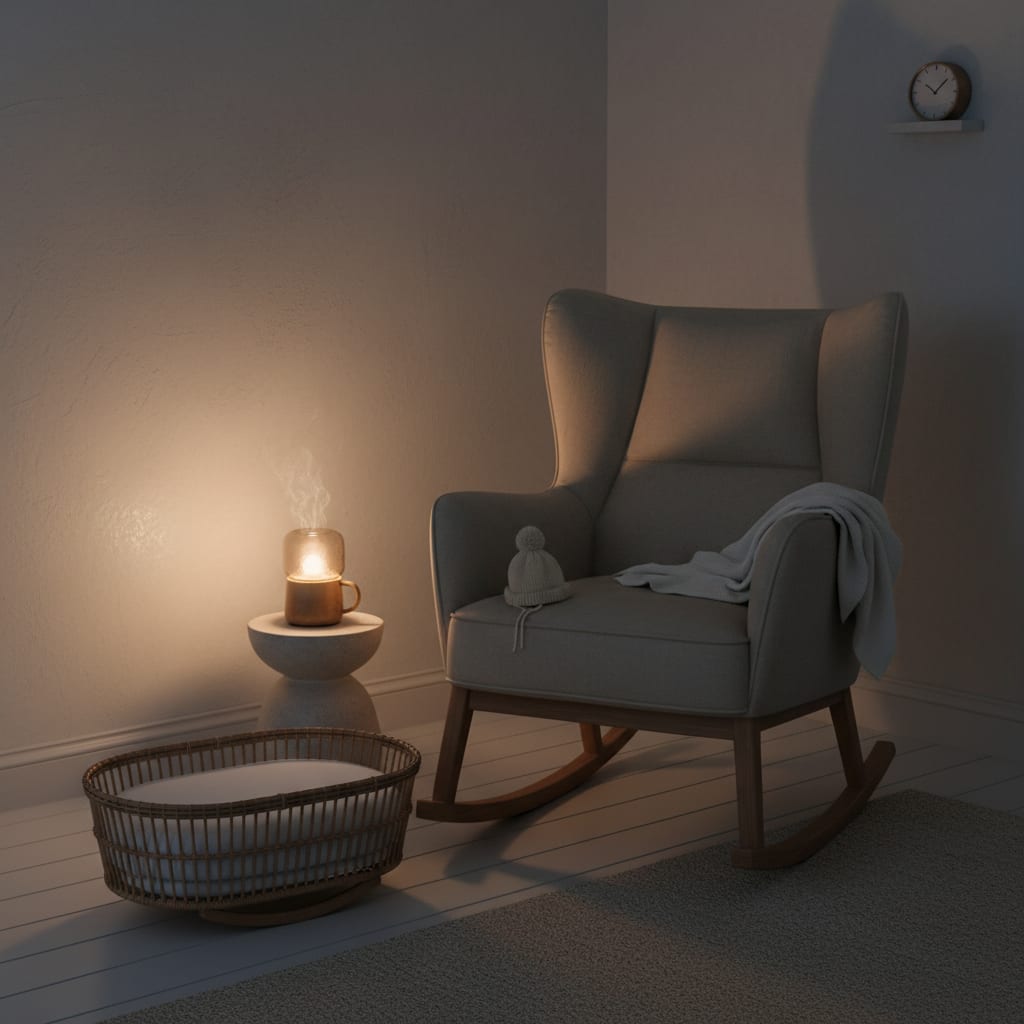
Carry the upstairs bassinet down each evening. This works if yours is light and its instructions say it can be moved. Carry it empty. Put it on the floor or on its own stand, never on a sofa, a table or a bed.
Keep a second sleep space downstairs. A play yard with a bassinet insert does the job and stays put. The Graco On the Go Pack ‘n Play is the kind I mean: a full-size infant bassinet level that sits on top of the playard frame. Whatever you choose, the AAP’s test is that it’s a crib, bassinet, portable crib or play yard that meets the Consumer Product Safety Commission’s safety standards.
Then set it up the same way as the one upstairs:
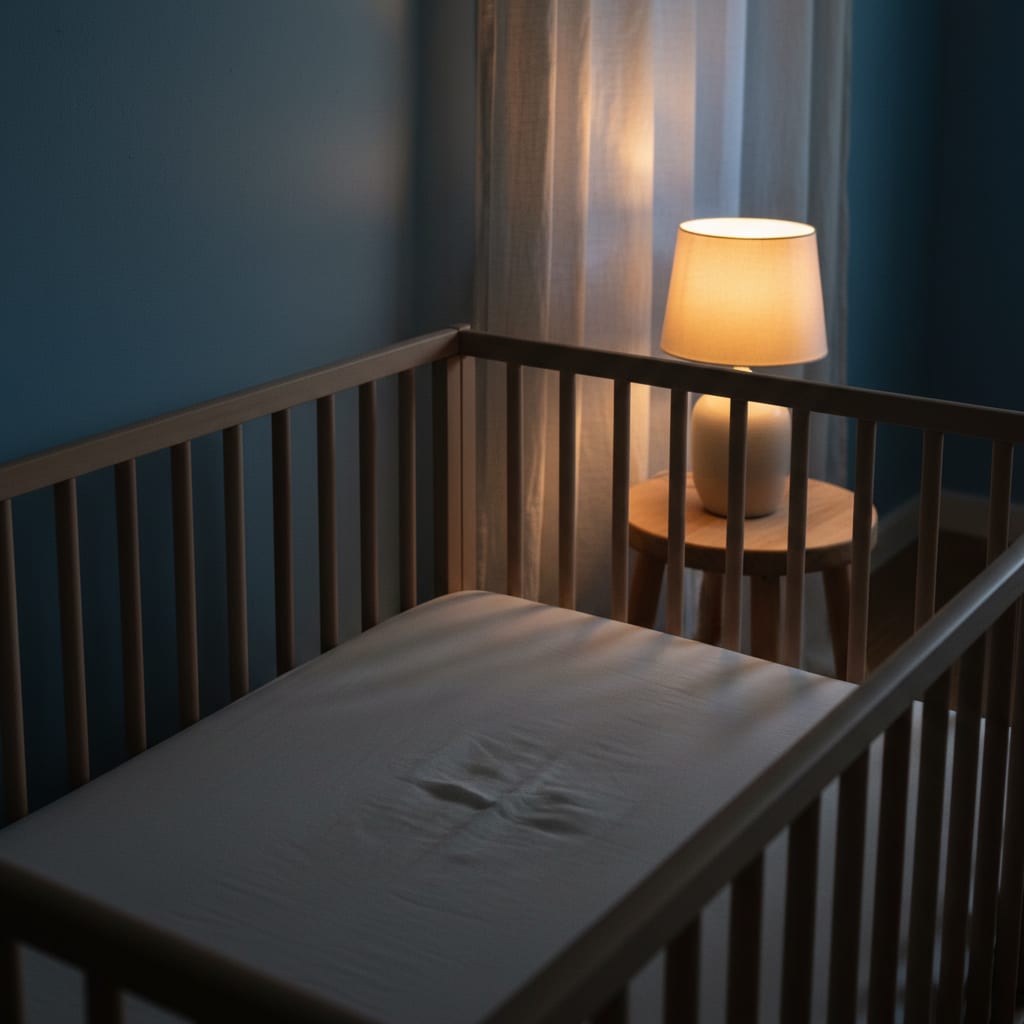
- Flat, firm, and empty. The AAP: “Use a fitted sheet only—nothing else should be in the crib with your baby.” No blanket draped in, no positioner, no rolled towel.
- On her back, every time, for naps as well as night.
- Dressed for the room. The AAP’s rule is one more layer than you’re wearing, and no hat indoors. Living rooms are often the warmest room in the house in the evening. Check her chest for the AAP’s signs of overheating: sweating, a hot chest or flushed skin. About 68 to 72°F (20 to 22°C) is the range to aim for.
- Close enough to see. Beside the couch is ideal. You want to be able to glance over without getting up.
If she won’t settle there at all, work through the checklist in newborn won’t sleep in the bassinet before deciding the room is the problem. Betteroo covers the rest of the room, from light to sound, if you want to fine-tune it.
When she falls asleep on you first
Most evenings she will. A newborn asleep on your chest while you are awake and watching her is one of the good parts, and our guide to evening skin-to-skin covers how to do it well.
Decide before you sit down what happens when your eyes get heavy. The bassinet sits beside you, already made up, and the moment you feel yourself going, she goes in it. If there’s another adult in the room, tell them to take her if they see you nodding off. If you’re on your own, put her down early.
Taking her upstairs
When you go to bed, she comes too.
- Get upstairs ready first. Bassinet made up, and what you need for the first night feed within reach.
- Carry her in your arms, not in the bassinet. You want one hand for the rail.
- Expect her to wake. Many evenings the trip upstairs becomes the start of the first night feed.
- Lay her on her back in the upstairs bassinet, and get into your own bed.
If two of you are splitting the night, the handover often happens right here, at the bottom of the stairs. Our newborn night shifts guide has a way to do it in thirty seconds.
What about a monitor?
A monitor lets you hear her. It doesn’t replace being in the room. The AAP says not to use home cardiorespiratory monitors as a way to reduce the risk of SIDS, and warns against letting wearable devices “give you a false sense of security.” The NIH says monitors “are not effective at detecting or preventing SIDS.” The Lullaby Trust says no device on the market can replace a parent or carer being in the same room.
This stage ends. The AAP’s room-sharing advice runs for at least the first 6 months. Betteroo has a guide to how the timing works after that, when a seven o’clock bedtime upstairs starts to make sense.
When to call the pediatrician
Call if she is younger than 3 months and has a temperature of 100.4°F (38°C) or higher, if she is very hard to wake for feeds, or if her breathing worries you. Ask, too, if she was born early or has a medical condition and you’re unsure how the sleep advice applies.
 When evenings start to have a shape
Betteroo builds a personalized sleep plan around your baby's age, so bedtime has a plan once she's ready for one.
Take the free sleep quiz →
FAQ: where a newborn sleeps in the evening
Can my newborn nap in the living room with the TV on?
Yes, in her own flat, empty bassinet or play yard, on her back. The safe-sleep sources care about the surface and about you being nearby. They don’t ask for silence.
Is it OK to leave her asleep upstairs with a monitor?
The AAP and NIH recommend sharing a room for at least the first 6 months, and both say monitors don’t reduce SIDS risk. The Lullaby Trust says day and night sleeps should be in the room with you, short trips out aside.
What time should a newborn go to bed?
In the early weeks, when you do. A set early bedtime comes later. For now her evening sleep happens near you, and her night starts when yours does.
Sources
- AAP (HealthyChildren.org): How to Keep Your Sleeping Baby Safe: AAP Policy Explained
- NIH Safe to Sleep: Ways to Reduce Baby’s Risk
- The Lullaby Trust: Room sharing
- AAP (HealthyChildren.org): Fever: When to Call the Pediatrician
More Sleep & Feeding for the next long night.